
Featured in
- Published 20250204
- ISBN: 978-1-923213-04-3
- Extent: 196 pp
- Paperback, ebook. PDF
THE TIP SHOP opens at 10 am every Thursday. By 9.50 am there’s a line at the gate at least ten people deep. There’s the old couple who resell whatever they find here on Facebook Marketplace; the man who wears thongs year-round, no matter the weather; the retired tradies who know their way through a bucket of screws and a row of rusted tools. Elbow to elbow they wait, each hoping to be the first across the line. Restless thoroughbreds at the starting gate. And there’s Dad, tall, standing to one side with his hands in his pockets. Already looking over everyone’s heads to see what’s in the yard.
It’s not even open yet and I’m already late. I squeeze into the last car park and walk over.
‘Hi Dad.’
‘Hi.’
We wait. This is quality family time.
‘No biting or scratching,’ the man who works at the tip shop says loudly as he unlocks the gate. We all laugh, but he’s only half joking. Last week the police were called to end an argument that had become physical. The man at the centre of it is now banned from the tip shop for life.
Dad knows all the regulars, as well as the staff, and gives me a summary of their recent health scares and paths to recovery as we walk around the yard.
‘He’s alright now.’ He always ends on a positive note.
We keep our hands in our pockets, poking things with our feet and saying ‘yeah, nah’. He spots a sun lounger that was here last week, but Mum has already said no to more furniture. She doesn’t come here anymore, preferring the op shop on the other side of our small beachside village, where she volunteers two days a week.
We reconsider the lounger for a moment. It’s only $10.
‘You probably don’t need a third lounger,’ I say, agreeing with Mum. I am immediately a traitor to the cause: our quest for the elusive bargain. Whether the object of our desire is needed is irrelevant.
Irrelevancy is why things often end up back at the tip shop: things are bought impulsively and returned later once the pleasure wears off.
Is this a graveyard or the afterlife? How many of these things were once part of a home, used to establish a sense of self and security? Coveted then fought over in bitter divorces, or hoarded until their owners die? Dumped later by the children who inherited them. Why do we buy things we don’t need? And when we choose to let them go, do they ever really leave us?
WHEN I FIRST moved to the south coast, I donated all my heels and half my clothes to the op shop, feeling I would have nowhere to wear my ‘city clothes’ now I was a mother living by the ocean, including a pair of black boots I still miss every winter.
I learn from one of the volunteers that the op shop is inundated with high heels. ‘Women move here and get rid of all their nice shoes,’ she says, loading more onto the buckling shelves. They bench the heels and buy a pair of Birkenstocks, perhaps struggling to imagine how their previous shoes will fit into a life shaped by school drop-off and beach days.
We never really ask ourselves what it is we’re giving up. Shedding one thing and replacing it with another to better define ourselves as we age and change, out of both practicality and personal choice. When is a shoe just a shoe and not something more insistent, fuelled by a hope that our careless decluttering will deliver what we desire most at the time?
Denis Diderot, the eighteenth-century French philosopher who edited the first known encyclopedia, expressed the notion of buyer’s remorse in his essay ‘Regrets for my Old Dressing Gown’: ‘I was the absolute master of my old robe. I have become the slave of the new one,’ he mourned. His new scarlet robe encouraged him to buy more things. A mirror over the mantle, a new leather chair, a new table. His consumption was reactive, and this is now known as the Diderot effect: when the purchase of one thing necessitates the purchase of another and another, a human habit leveraged to great effect in marketing psychology.
I find some comfort in knowing that a philosopher hundreds of years ago faced these familiar struggles. Only now, thinking of the acres of landfill that did not return to the circular economies of op shops and buy-back centres, there’s the guilt of our environmental impact, inseparable from the accelerated consumerism we grew up with as children.
When I came of age, shopping centres had become the heart of the suburban and semi-rural outskirts where I lived. The mall was the perfect setting for our teen-girl adolescent dramas. We walked the tiled floors and looked for boys. We wore tiny clips in our hair and tight plastic chokers. We needed new clothes like our lives depended on it, because they kind of did. We lived on a diet of McDonald’s and comparison. Bought tops that matched those of our friends and believed in the reflection of ourselves that we saw in each other. We already had a sense that our bodies were here to be looked at.
The things we bought were welcomed into our lives like lost friends. Where have you been? But we asked little of them and were happily surprised if they surpassed the standards we had lowered in the name of price and convenience. Cheap became synonymous with good, sale with pleasure. These items we gathered around ourselves were only to be loved briefly. Here for a good time, not a long time – a consumerist manifestation of our new collective philosophy. Within the year they would be discarded, most likely broken. Swapped for something else immediately necessary and equally forgettable. Always plastic, synthetic. Always replaceable. It didn’t matter, as long as it was new.
Diderot had nothing on a teenage girl with a twenty in her pocket.
THERE’S ONE LAW at the tip shop: whoever touches it first owns it. Possession is a matter of speed and timing. Young children adopt this same rule and later learn to break it when they discover a social need to share. It persists in adults in different ways. I see it in the pile of things each person makes as they move through the yard.
‘I don’t know why they get so worked up. Everything comes back eventually,’ one of the staff members says, reflecting on a fight he broke up recently over an old set of scales.
‘People are finding it harder to afford things, so they come here,’ he tells me. Some of them are hard up, others are regulars who like the thrill of the hunt.
Local folklore says the tip is the place to find vintage surfboards. Everyone I speak to knows a guy who knows a guy, but no amount of digging leads me to them.
‘It’s serious business,’ one friend reveals. ‘There’s a guy…’
This mythical figure is known to unearth rare surfboards and bodyboards from the stack of rotting and broken fibreglass at the tip. The rumour brings waves of hopeful surfies each week, men who trawl through the pile and leave empty-handed.
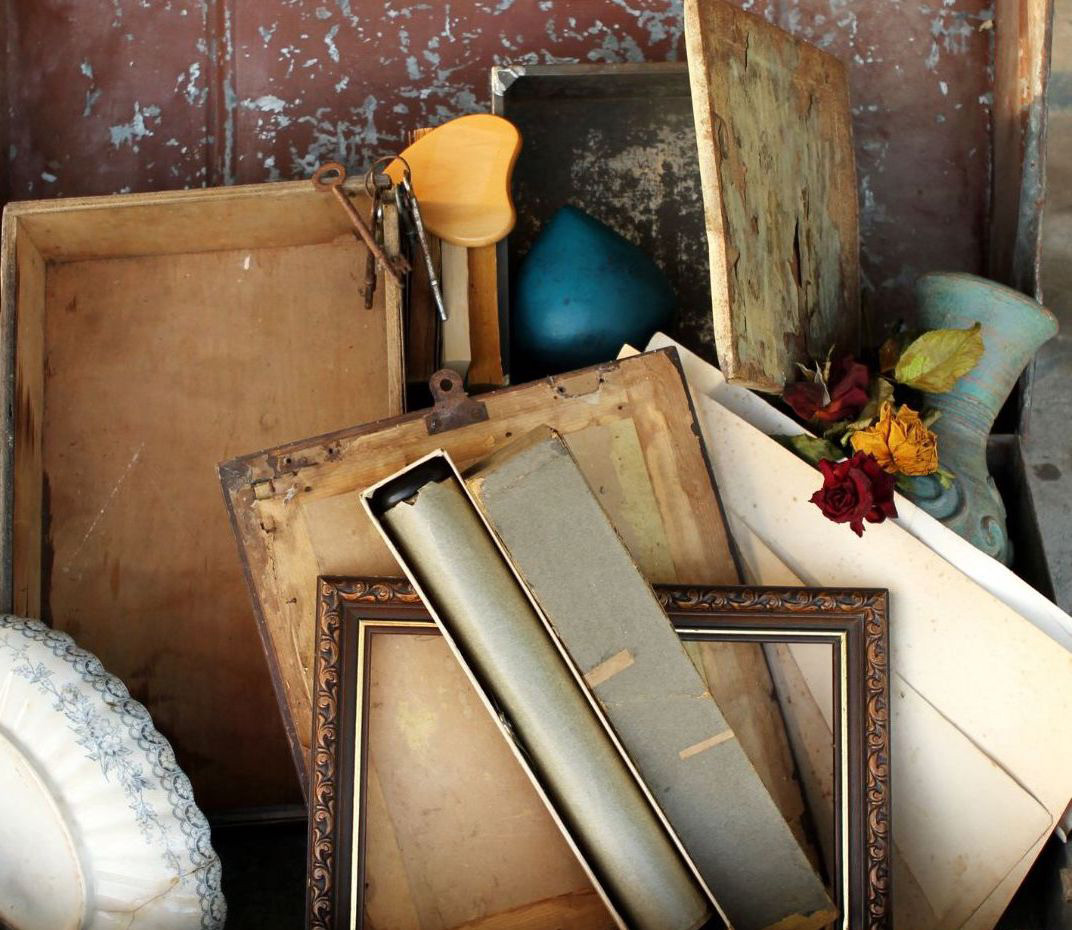
The tip shop creates a vacuum of sentimentality. This only adds to the thrill of the hunt, where the search becomes bigger than the thing itself. In that moment, time alters. The past and present merge and we step outside, just for a second, the familiar cycles of desire and need that shape our daily lives. For a moment, something can be treasured, even if the object of our fantasy exists only in our minds. We look for it in the piles of things people leave behind, searching through the rubbish; all we’re really looking for is ourselves. Reflected back to us are the rain-washed artefacts of our consumption that are lined up and sorted on pallets and old tables. The metallic shells of old fireplace flues, stacks of doors and aluminium windows, fishing nets and old tyres that fill the outside lot. And inside: old Tupperware containers; several plastic lids, the kind you put over food warming in the microwave; all of Stephanie Meyer’s books; a DVD box set of Felicity; every movie starring Katherine Heigl; novelty mugs and champagne glasses. Written in the debris is the history of recent contemporary experience. Ruled over by the great arm of the excavator that claws through the waste on the other side of the fence.
WHEN I WAS a child, before I discovered shopping centres, Dad would bring home old broken bikes he found on the side of the road or at the tip and pull them apart. He reassembled the pieces into something new that worked – a bit from here, a bit from there. He built bikes for my brothers. When I outgrew the small pink bike with training wheels, it was my turn. I hung outside the shed, buzzing and impatient, while he magicked it all together, the bike chain resting in an old ice-cream bucket full of oil. Nothing new could compete with the bike Dad gave me that day (the way we remember the things that give us ourselves): a not-so-badly rusted frame to which he added ape handlebars and white wall tyres. The brakes didn’t work but I quickly figured out how to jump off while it was still moving. Easy enough. He’d fix those next time. Off I went, around the long arm of the street, joining up with the other neighbourhood kids. We swerved in a pack along the semi-rural streets, stopping on a hot afternoon to gulp water from taps when we saw them in a neighbour’s front yard, avoiding the occasional car and dog. Picking up more kids along the way. There was no hierarchy; we were brought together only by proximity and our new-found independence. All you needed was a set of wheels.
THERE’S A STACK of old bicycles rusting in one corner at the tip shop. I wheel a child’s bike out and look it over with Dad. My son, Joey, needs a bigger one. When he peddles down the street at home, his knees come up to his chest. This is a classic Mongoose BMX with a heavy welded frame, flat tyres and a broken brake cable. Dad and I agree, it’s perfect.
I show the bike to Joey after school and we chatter excitedly about all the ways we’ll fix it up and make it his.
‘It’s a great bike, Joey. It’s a Mongoose,’ I say. Which means nothing to him until now. He traces a finger over the logo embroidered on the seat.
As I pull it off the ute outside the bike shop where it will be repaired, a man stops and watches.
‘Nice bike, mate,’ he says as we wheel it past.
Joey puffs his chest.
‘It’s a freakin’ Mongoose,’ he whispers.
Image by Moppet via Canva.com
Share article
About the author
Brooke Boland
Brooke Boland lives and works on Yuin Country in regional NSW. Her work has appeared in Meanjin, Overland and the Sydney Review of Books. Her non-fiction...
More from this edition
Home is a long way away
Non-fictionThe Australian housing market is a wealth-generating machine, not a home-generating machine. So much is wrong with the current situation. No doubt you see it too; everybody seems to on some level. That’s why we keep hearing about the ‘Australian housing crisis’. I can see it, and I proudly consider myself an old-school capitalist, with a preference for free enterprise, fair competition, private property rights and the chance to make an occasional profit. We now find ourselves with a de facto caste system in Australia: the home owners relative to the home renters. Both groups need homes, but there is a marked wealth division between those collecting passive income on houses they own and those living solely on direct income who are forever chasing a rising market.
Songs of the underclasses
Non-fictionDiē was the best driver I knew. ‘When you drive, you stare at everything but see nothing. You’re inexperienced,’ he lectured. ‘When I drive, I stare at nothing – I can chat, I can sing. But I see everything. Parking spaces, jaywalkers with a death wish, doggies and kitties. And for hours at time, without breaking concentration. It’s like meditation.’ Diē’s love language included showing me footage of near-miss traffic incidents on WeChat. Each trip of ours decreased my risk of appearing in his feed. These hours became the most time we had ever spent together.
Mudth
Non-fictionMy family has its roots in several parts of the world: the Lui branch in New Caledonia, the Mosby branch in Virginia in the US, and the Baragud branch in Mabudawan village and Old Mawatta in the Western Province of PNG. Growing up, I spent most of my childhood with my Lui family at my family home, Kantok, on Iama Island. Kantok is a name we identify with as a family – it’s not a clan, it’s a dynasty. It carries important family beliefs and values, passed down from generation to generation. At Kantok, I learnt the true value and meaning of family: love, unity, respect and togetherness. My cousins were like my brothers and sisters – we had heaps of sleepovers and would go reef fishing together, play on the beach and walk out to the saiup (mud flats). I am reminded of these words spoken by an Elder in my family: ‘Teachings blor piknini [for children] must first come from within the four corners of your house.’
