The animal in the walls

On the rise of the fungal gothic

Featured in

  • Published 20231107
  • ISBN: 978-1-922212-89-4
  • Extent: 208pp
  • Paperback, ePub, PDF, Kindle compatible
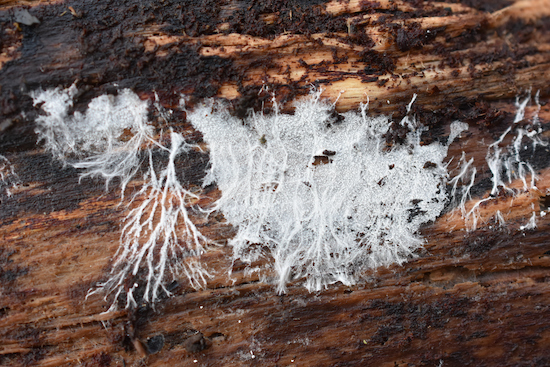
‘CHILDREN, DID YOU ever try to define the difference between an animal and a vegetable?’ asks the freethinker and writer Elmina Slenker in her 1887 almanac for ‘little folk’. ‘It is easy to tell a cow from a tree, or a man from a potato. But when you take some of the lower forms of life and compare them, you will not find so much difference.’ Slenker gives her young readers the example of the plasmodial slime mould Fuligo septica, a bright-yellow unicellular organism born from a spore, which throbs and creeps over rotting tree trunks and leaf litter in its search for nutrients. Dividing itself, fusing with compatible amoeba it encounters and stretching upwards of two feet in length, the plasmodium will eventually fruit and burst into spores that start the cycle again. Slenker describes this organism as a ‘fungus plant’, which, ‘when placed under certain conditions, will change into an animal’ – a calmly scientific description of a folkloric wonder.

Slime mould (which is actually neither animal nor vegetable, nor even mould nor fungus, but an Amoebozoa) is one of the murky epistemological border dwellers that broke the two-kingdom system for classifying living things. In Western culture, writes theorist Jeffrey Jerome Cohen, these fissures in the classificatory ‘order of things’ have habitually spawned monsters. The compound living-dead flesh of Frankenstein’s creature; the wolf-rat-humanoid form of Dracula; the bivalve-reptilian Xenomorph – these monsters are ‘disturbing hybrids whose externally incoherent bodies resist attempts to include them in any systematic structuration’.

Already a subscriber? Sign in here

If you are an educator or student wishing to access content for study purposes please contact us at griffithreview@griffith.edu.au

Share article

About the author
Robbie Moore

Robbie Moore is a senior lecturer in English at the University of Tasmania, where he teaches a variety of subjects, including the Victorian gothic....

More from this edition
A life with horses 

In ConversationIn 2011, I was invited to a writers’ retreat in Santa Fe. It was held on a lovely old ranch with beautiful horses – Western Paints, Appaloosas – and one of the wranglers noticed me admiring them and invited me on a trail ride. It was an ecstatic experience.

Fish

FictionHe hasn’t caught one in twelve years or more, not since just before Ritchie – Hayley’s oldest – was born. The deboning alone can take half a morning and you have to strip that tail to its cartilage very carefully because there’s a layer of green resin, bitter. In small doses it ruins the meat; poisonous if you eat too much.

Mother of pearls

FictionBut we are more animal now than we’ve ever been. We read the water that leaps into our pools; we filter all kingdoms of life through our gills. We understand that the tendrils connecting one life form to another run much longer and deeper than you might expect. And we can entertain the notion that our strange tasks were like the fateful beats of a butterfly’s wings, and maybe the witch was a rare genius, able to perceive how the purloined dog, the pawned bird or the swapped cats would, in the mysterious rippling of the universe, lead to our deepest desires coming to pass. 

Stay up to date with the latest, news, articles and special offers from Griffith Review.