
Painting behind bars
The art of fighting for freedom
Featured in
- Published 20250204
- ISBN: 978-1-923213-04-3
- Extent: 196 pp
- Paperback, ebook. PDF
Artist and activist Mostafa Azimitabar, better known as Moz, has twice been a finalist in Australia’s most prestigious portrait prize, the Archibald – yet he’s not legally allowed to study in this country and must reapply for his bridging visa every six months. After reaching Australia by boat in 2013, Moz was immediately detained by the Australian Government and exiled to Manus Island with 1,500 other refugees. To survive his imprisonment, he began to paint with the only tools he had at his disposal: a toothbrush and a cup of instant coffee. Now a free man and an acclaimed artist, Moz is using his voice to speak up for the rights of refugees: those locked up in detention and those who have been waiting more than a decade for a permanent visa. He continues to use his toothbrush to create art that embodies his message of love and hope.
CARODY CULVER: You were born in Iran in the 1980s, when the country was at war with Iraq; you’re also part of Iran’s persecuted Kurdish minority. So you grew up in an environment of intense civil unrest and extreme violence. When and why did you realise that you had to flee?
MOSTAFA AZIMITABAR: I was twenty-seven years old and I was a human-rights activist, and [the government] was monitoring me – it was a very stressful time. I was in danger and I had to escape Iran.
CC: Kevin Rudd, Australia’s then prime minister, had just announced that if you were an asylum seeker who’d come to this country by boat, you wouldn’t be allowed to settle here – so you were immediately detained. You went to Christmas Island and then you were transferred to Manus Island, where you were imprisoned for the next six-and-a-half years, is that right?
MA: Yes, when we arrived on Christmas Island, we heard about the new law. When we were on our journey to Australia, the law changed. If I had arrived just a few days before, I wouldn’t have been in detention for eight years [in total]. Just because [of] a few days.
CC: And when you were on Manus Island, this is when you turned to visual art – can you tell me about the day you began to paint?
MA: When I was twenty-eight, a year [after I was exiled to Manus], I decided to do some paintings. There were some caseworkers and a couple of them brought some small acrylic paints in a small box…imagine four or five small acrylic paints, different colours, for 500 people. It was impossible to [do] the painting, nearly impossible, and I was very shy because I was not sure – I didn’t want to paint in front of everyone else because I was not an artist, I was not a painter, I didn’t have the confidence to do that. That is why I wanted to [paint] in my tent. But if any refugee tried to take paint into the tents – or even other stuff, like nail clippers – then officers would search all the compounds [and subject us to] pat-down searches. Some of the officers would destroy our belongings.
In Oscar Compound there were ten tents, and in each tent there were fifty refugees. Twenty-five bunk beds. There was no space for breathing, [we were] so close to each other. There was a small table in each tent. I remember there was a cup of coffee on the table and a toothbrush beside it. It was not nice coffee…it was instant coffee, horrible. I think that was one of the things that helped me, because I didn’t want to drink it! And a couple of hours before, I had a conversation with some security guards [and said] I would like to paint, could you please provide some paint for me? One of them said, it’s not possible, it’s a chemical and you cannot have this stuff in the tent because you might eat it and then it kills you. I felt really upset – why do they think that I’m going to eat the paint? So when I came [back] to the tent, there was the cup of coffee and there was a toothbrush beside it. I don’t know, suddenly I just grabbed the toothbrush and [started to paint with the coffee] – it made me laugh, it made me smile. I think that was a great moment in my life. I believe sometimes when we capture the moment we can become successful. I smiled deeply and said to myself, they can’t take this from me.
CC: I’m very glad that you picked up that toothbrush, Moz! You said before that you felt shy about painting in front of other people. When you started painting with the toothbrush, did that lack of confidence fall away?
MA: No, I was so shy – I didn’t understand that art can be simple. I thought maybe I was not good enough to show [my work] to everyone, and I didn’t know how to make paintings like [the ones I create now]. I didn’t know how to work on it [or know that] if the coffee is strong, the colour gets more obvious. But I kept it in my heart and I practised [painting] a few things: a mountain, a river, a flower. I love to paint mountains.
CC: You and some other refugees were brought to the mainland in late 2019 to receive medical treatment, but your detention continued – you were imprisoned in a hotel for fourteen months before finally being released on a bridging visa in 2021. You took the government to court over your hotel detention in 2022, and unfortunately the court ruled that your detention was lawful (albeit lacking in care and humanity). Why was it important to you to speak up and try to change the system?
MA: I was a teenager when I [first] talked about human rights. I learnt how the Iranian Government was torturing political activists in different ways. When I was on Manus, I saw a similar type of torture. For example, indefinite detention means that you might be locked up forever – no one knows when you get free. You never get to Australia. And [in the media] you hear people like Peter Dutton talking about asylum seekers as illiterate, dangerous, illegal. So I remembered this and I looked at everyone, the refugees around me, and I saw that these people were not dangerous, they were not illiterate. I couldn’t ignore it. When we were transferred to Australia for medical treatment, they locked us up in a hotel without access to any fresh air, any activities outside the hotel. Most of the time I was in a room for twenty-three hours with one hour outside in a corridor or in the kitchen. Absolutely horrific – we are human beings. We haven’t committed any crime. If we cannot stand up for our rights, then they make it worse for us. That’s why I talked to the media about it every day when I was in the hotel. I sued the government for my humanity and to embarrass the racist system that has created this massive division between us.
CC: Do you see your art as a form of resistance or activism?
MA: Every time I grab a toothbrush, it makes me smile that [this all began] at Manus. I mean, this technique comes from suffering. This is not from university. I am forbidden from studying or getting a qualification here, but sometimes we can learn from suffering. I am managing to heal my trauma [with] painting. Whenever I feel sad, I paint. Whenever I feel happy, I paint. It’s like a treasure, how can I explain it? It’s invention, it’s something that hasn’t happened before. Everyone uses a toothbrush, but when I paint with a toothbrush I feel it helps me understand that my work, the marks I make, are very unique. It brings the story back. I don’t want people to forget about the story because I don’t want to escape from who I was, who I am. I would like to share the truth that this happened to me.
And I can learn, even if the government doesn’t let me study! I actually teach art at the Art Gallery of New South Wales – sometimes schools come to the gallery and I teach the students about the concept of art, and I do workshops with them and share my story. We provide the art supplies for them, including coffee and toothbrushes, but other stuff as well – if they don’t want to use a toothbrush that’s totally fine because everyone has their own way to learn. I tell everyone at the end that they are artists – I say, when anyone asks you to introduce yourself, say that you are an artist.
CC: I love that! Your art has also led you to forge some really special friendships, including with the artist and filmmaker Angus McDonald. Angus invited you to come and paint in his studio – can you tell me how you and Angus got to know each other?
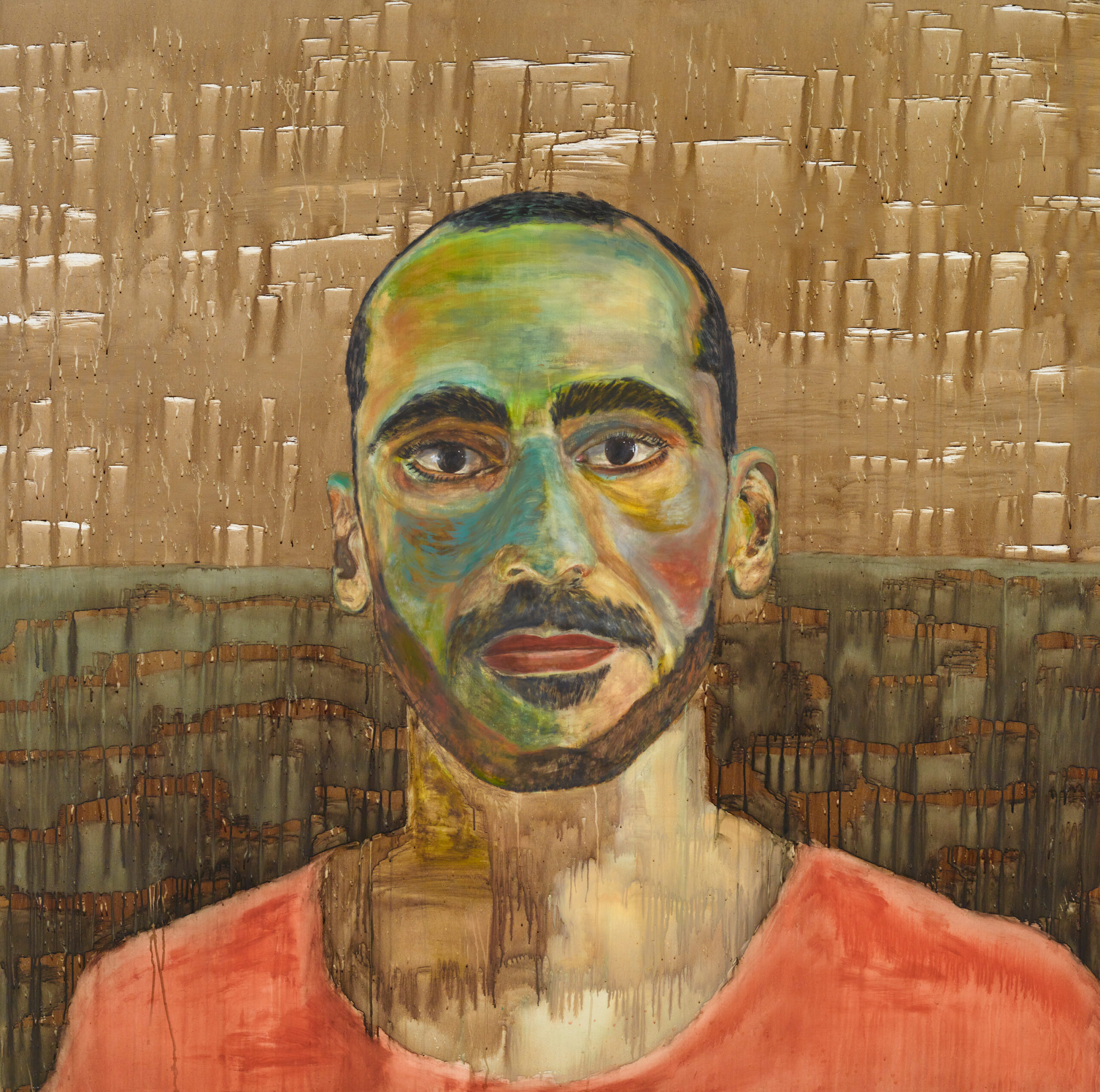
MA: My friend Craig Foster introduced me to Angus. I was in the Park Hotel prison and Angus told me that he would like to make a film [the 2023 documentary Freedom Is Beautiful] about my story and a fellow refugee, Farhad Bandesh, and I agreed. When I won my freedom, I shared some paintings with Angus. I painted some new stuff and he said, maybe you could come and paint a self-portrait? I had never done that before. It was Angus who introduced me to the Archibald Prize – we were working on the film and he talked about it and said, ‘this is the top art prize in Australia’, but I was not sure [about entering] – I said, but I am not an artist like you! There are amazing artists in Australia. And he said don’t worry, it’s not like that. So I went to his studio and he provided some art supplies for me and I brought toothbrushes and coffee. He really liked it when I said that I was going to paint a self-portrait with a toothbrush and coffee.
When I finished the painting, Angus took it to a framing shop and then arranged transportation to the Art Gallery of New South Wales. We submitted to the Archibald [in 2022]. After a couple of weeks, I got a phone call from the gallery [to say] that I had been selected as an Archibald Prize finalist. I felt I had a pair of wings – and I wanted to fly from happiness. I felt that this news was going to heal eight years of the trauma of detention. Do you know something? If I was not on Manus, I wouldn’t have this story.
CC: And you’ve been an Archibald finalist twice now – in 2022 with that self-portrait and then in 2024 with a beautiful portrait of Angus. It’s so lovely that those two pictures have both ended up as finalists. You often say that your message is love. Why is it important for you to spread this message of positivity and hope, particularly in the face of the brutality and the lack of empathy you’ve faced over the years?
MA: I was tortured in detention massively. But I am not going to blame people who are living in Australia. I feel that these people are different from the ones who locked me up. The government are blaming refugees, so I decided to change the narrative – I wanted to show that I don’t hate people in Australia. I don’t believe in hate. What they are doing is wrong and I shouldn’t use the same hate against the system. I can use love because people are nice, people are kind. This message can bring us together and make us free.
Image: KNS088 (self-portrait), Mostafa Azimitabar, 2022, 190.5 x 191.8 cm, coffee and acrylic on canvas, painted with a toothbrush
Share article
About the author
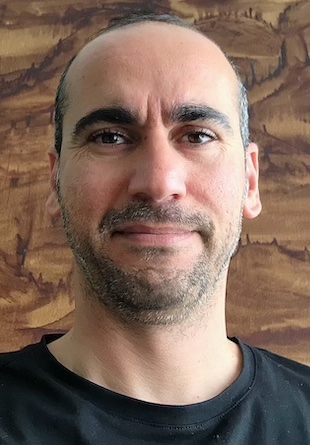
Mostafa Azimitabar
Mostafa Azimitabar is a human-rights activist and two-time Archibald Prize finalist. As a refugee from Kurdistan, his status as an Australian resident is yet...
More from this edition
Home as a weapon of cultural destruction
Non-fictionIt was simply expected that Aboriginal people would accept the values and behaviour of the dominant European culture. The Welfare Board insisted that Aboriginal people not only earn an independent living but show the Board they could save money in a bank account. They had to demonstrate that they were avoiding contact with other Aboriginal people and refusing to participate in community-oriented activities, such as sharing resources with kinsfolk and travelling to visit their relatives and home Country. Over and over again, the Board’s reports criticised Aboriginal people for being among their own kind and clinging together in groups. To achieve their assimilation aims, the Welfare Board implemented a crude ‘carrot and stick’ incentive in an attempt to modify Aboriginal behaviour: if Aboriginal people could convince the Welfare Officers that they had cut themselves off entirely from their culture, family and land, they would be rewarded with an ‘Exemption Certificate’.
No secret passageway
Non-fictionIn 2001 I read an article in The Guardian newspaper about a man who fell from the sky, landing in a superstore car park not far from where I live in London. The article, by journalists Esther Addley and Rory McCarthy, detailed how the Metropolitan Police discovered the dead man’s identity through a combination of luck, Interpol and British-Pakistani community workers. Muhammad Ayaz had managed to slip through security at Bahrain airport, run across the tarmac and, according to witnesses on the plane, disappear beneath the wing of the British Airways Boeing 777. The article quotes a spokesman from the International Air Transport Association: a myth circulates that there is a ‘secret hatch from the wheel bay into the cargo bay, and then into the passenger cabin, as if it were a castle with a dungeon and a series of secret passageways’. No such passageway exists and Muhammad would have found himself trapped in the wheel bay with no oxygen, no heating and no air pressure as well as no way out. If he wasn’t crushed or burned by the retracting wheels, he may have frozen to death once the flight reached 30,000 feet, finally falling out hours later when the plane lowered its landing gear as it prepared to touch down at Heathrow.
The blue room
FictionMum did not tell us that Sabina had tried to kill herself. She said that she was unwell, and because she was unmarried and her children lived interstate Sabina would stay with us while she convalesced. We figured it out after she arrived; she did not appear sick, but lively and plump. Nor was there any regularity to her medical appointments. Though Phoebe was irritated that she would have to share her bathroom we found the situation morbidly glamorous, the sick woman with the elegant name whose stay would end with recovery or its opposite. So many sibilant words: suicide, convalescence, Sabina. Having no knowledge of death or any conviction we would ever die, suicide seemed tinged with romance. That Sabina lived confirmed our belief that death was not serious.
