
Featured in

- Published 20240806
- ISBN: 978-1-922212-98-6
- Extent: 216pp
- Paperback, ePUB, PDF


Already a subscriber? Sign in here
If you are an educator or student wishing to access content for study purposes please contact us at griffithreview@griffith.edu.au
Share article
More from author

No secret passageway
Non-fictionIn 2001 I read an article in The Guardian newspaper about a man who fell from the sky, landing in a superstore car park not far from where I live in London. The article, by journalists Esther Addley and Rory McCarthy, detailed how the Metropolitan Police discovered the dead man’s identity through a combination of luck, Interpol and British-Pakistani community workers. Muhammad Ayaz had managed to slip through security at Bahrain airport, run across the tarmac and, according to witnesses on the plane, disappear beneath the wing of the British Airways Boeing 777. The article quotes a spokesman from the International Air Transport Association: a myth circulates that there is a ‘secret hatch from the wheel bay into the cargo bay, and then into the passenger cabin, as if it were a castle with a dungeon and a series of secret passageways’. No such passageway exists and Muhammad would have found himself trapped in the wheel bay with no oxygen, no heating and no air pressure as well as no way out. If he wasn’t crushed or burned by the retracting wheels, he may have frozen to death once the flight reached 30,000 feet, finally falling out hours later when the plane lowered its landing gear as it prepared to touch down at Heathrow.
More from this edition

The great divide
In ConversationIn the ’80s, and maybe the early ’90s, fashion was a political statement just like art was…and real art wasn’t about selling out or succeeding in a mainstream context; it was the opposite. The whole idea was that you didn’t want to conform. Anyone who was trying to make money off your art or helping you make money was corrupt or compromised. The last thing you did as an artist or a writer in the ’80s was self-publicise – it was so naff, it wasn’t done. Street cred was what mattered. And I’ve been watching, with social media and the internet, this 180-degree shift over the last few decades.
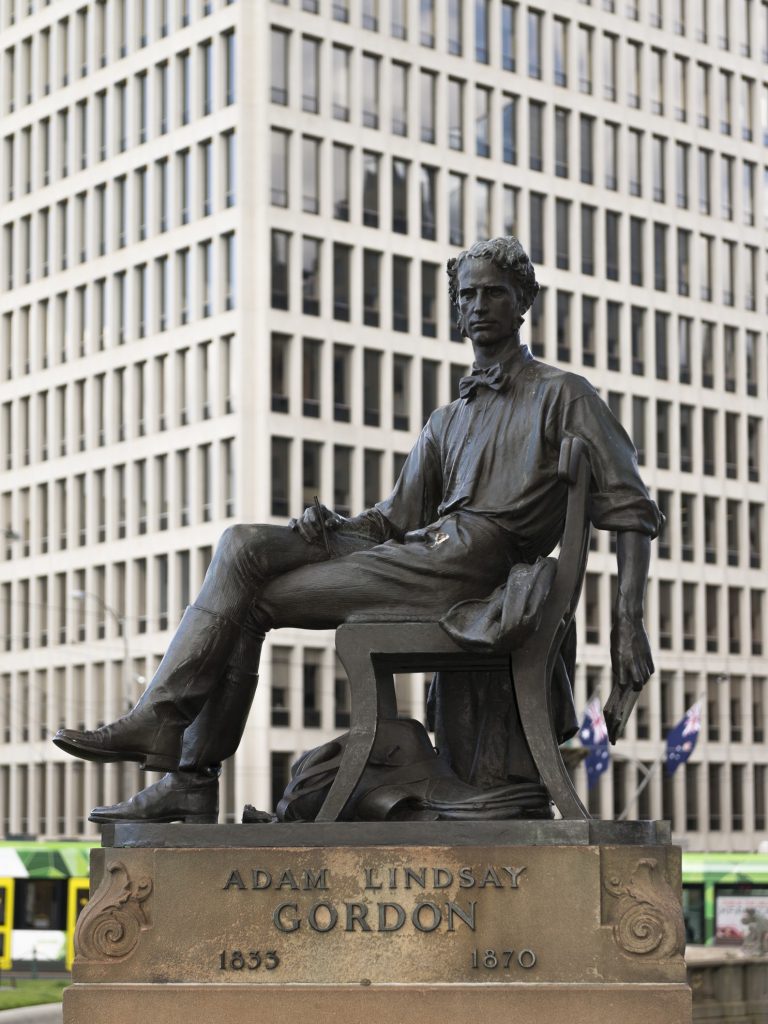
The Gordon cult
Non-fictionFrom a modern perspective Gordon makes an odd choice for a national poet, since he wrote only rarely about the country that embraced him. He set many of his popular verses in England and studded the others with the classical references familiar to an English gentleman. Yet before the passage of the 1931 Statute of Westminster – or, more exactly, until similar laws passed through the Australian Parliament in 1942 – Britain retained the legal right to determine foreign relations for the Australian Commonwealth. Accordingly, prior, during and for some time after the Great War, respectable Australian nationalism generally manifested as Empire patriotism.

New shoes
FictionThis is where I work: the kind of sneaker store that stocks shoes with the names of famous American rappers or athletes. The kind of sneaker store with plywood everywhere and hip-hop and young staff who look like customers except for their fluoro lanyards. Tomorrow a famous American basketballer will drop his new line of shoes. At our morning catch-up, Corrine reads out a list of names. It’s the staff who have pre-paid for the shoes. I am on the list, and Jules and Ruby are too. Corrine reminds us that this is a ‘privilege’ for staff.
